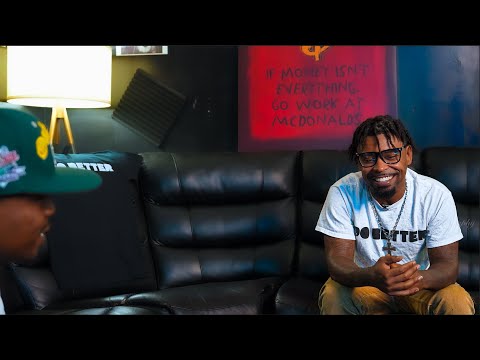



What Megan Mosholder talks about
Megan Mosholder came on From The Ground Up with DJ Ray on Di-VerZe HitZ Radio in September 2022. She is a site-specific artist who builds large installations out of string, and over 53 minutes she talks about how she got there, the pieces that changed her career, and the accident she worked her way back from.
She was born and raised in Columbus, Ohio, where she taught art for four years at an urban public charter high school. In 2010 she moved to Savannah to study at SCAD, then moved to Brooklyn, finished graduate school and worked with the artist Teresita Fernández, who became a mentor. She says she felt her chances were better in New York for the kind of work she does, and that the best way to get her to do something is to tell her she can't.
“I think the best way to get me to do something is to tell me that I can't do it.”
Megan Mosholder · at 5:58
Her medium came out of conflict. When she told her graduate professors she would use glow-in-the-dark string and black light for her thesis show, they called it kitsch. Back in her studio she started building string barriers, almost walls against the criticism, and kept going. She first used nylon, then switched to polyester because it is more durable and stretchy, and string had a practical side too: unlike heavy 4-by-8-foot painted panels, she can pack it in a suitcase and make something huge. Both of her art degrees are in painting.
“Giving up feels like a dumb sentence to me. Like what's the point of living if you're not going to try?”
Megan Mosholder · at 27:21
She describes a visiting artist stay in Beijing in 2016 and the piece that opened doors: a 53-foot string installation she built for Google's offices in Pittsburgh after a friend showed her work to the architects. In Atlanta she made the piece at Skylark Apartments, designed as one experience for residents inside and another for the neighborhood outside, with mirrored stainless birds reflecting the sky. She also talks about building work in Europe, bringing five people with her to Italy, and finding Microsoft through Instagram while she posted progress shots of Skylark.
“I'm also a site-specific artist, so again, that means I'm making work about the place that it's in.”
Megan Mosholder · at 39:25
Then there is the crash. Exhausted after moving from Tulsa back to Atlanta, she is believed to have fallen asleep at the wheel; her car flipped, caught fire and trapped her until a police officer pulled her out. Weeks later she was working from bed with clients and assistants, and today she works with a prosthetic leg. Giving up, she says, makes no sense to her. She closes with practical advice for artists, including the NYFA Source database for grants and residencies, and a simple rule: you are allowed a bad day, but the next day you get up and go.
“You're always only as strong as your community, and if you want people to invest in your work, you have to invest in theirs.”
Megan Mosholder · at 44:25
“You're allowed to have your bad day, but the next day you got to get up and go.”
Megan Mosholder · at 51:48
Key moments
Each chapter opens the interview on YouTube at that point.
- Intro2:02
- Columbus, SCAD and Brooklyn2:03
- Choosing art as a career3:03
- The thesis show and kitsch3:00
- Beijing in 20162:03
- The Google piece3:04
- Why string works5:05
- Skylark Apartments in Atlanta4:04
- The accident and recovery4:08
- Team building on big projects7:08
- Travel and site-specific work6:04
- Microsoft, Instagram and resources4:03
- What's next and social media5:24
- Advice: get up and go1:56
About Megan Mosholder
Megan Mosholder is a site-specific installation artist based in Atlanta, originally from Columbus, Ohio. She studied at SCAD, finished graduate school in Brooklyn, and holds master's degrees in fine arts and education. She worked with the artist Teresita Fernández, taught high school art for four years, and has built string installations for Google in Pittsburgh and for Skylark Apartments in Atlanta. Her work is at meganmosholder.com and on Instagram as @meganmosholderart.
Follow Megan Mosholder: Website, Instagram.
Full transcript
Read the full transcript (9,368 words)
From the video's automatic captions, lightly cleaned. Timestamps open the video at that point.
0:00I know. You're listening to From the Ground Up Show with DJ Ray on Di-VerZe HitZ Radio. Your number one source for 24/7 non-stop entertainment. I need y'all to tell a friend and tell a friend and tell a stranger because what guess what? We know over here at Di-VerZe HitZ Radio, strangers support you the most. So, guess what? Tell a friend and tell a stranger to go ahead and download that Di-VerZe HitZ Radio at your app store. It is free and we know y'all like free stuff. I've been told that, you know what I'm saying? So, look go ahead and download that and while you're at it, I need you to go ahead and subscribe to our YouTube channel. That is free by the way. Look, support is free. It does not take nothing to go ahead and like and subscribe to see what's going on, you know what I'm saying? Look man, we have a special guest in the building today. If you did not know, if you have not been watching the flyers or watching any promotion or you just been under a brick wall. Look man,
1:01We got Megan Mosholder in the building. If you do not know who Megan Mosholder is, you got to wait and find out in about 15 more minutes, you know what I'm saying? Because she is here for a specific reason, but you know on Di-VerZe HitZ Radio, this is called From the Ground Up. So, guess what? We're going to find out who she is first and then we'll get into why we chose to bring her here on Di-VerZe HitZ Radio. So, with no further ado, may you please go ahead and introduce yourself to the Di-VerZe HitZ Hi there. How's it going? I finally made First off, how was the traffic, you know? I mean, it's Atlanta, so it's always intense. Intense traffic. I was coming from Smyrna. So, a bit of a bit of a trek, but definitely worth it. I'm extremely grateful. Thank you so much for having me and for your interest in both me and my work. first off, let the people know where you're from.
2:02It's kind of a complicated answer. So, I'm originally from Columbus, Ohio. That's where I was born and raised. Never thought I'd leave. And then in 2010 I moved to Savannah, Georgia to go to the Savannah College of Art and Design. SCAD. Yeah. And then had to get out of there. I ended up in Brooklyn. Finished graduate school working with an artist named Teresita Fernández. Um, who is a world-famous installation artist. And she's really the reason why I work the way I work. She pushed me out of my comfort zone. Met her in Southern France. I was there for a few months. Um, and ended up wrapping over 400 white pumice rocks and sewing thread to impress her and remind her that she gave me a verbal yes to that internship. And it worked. Uh, but I damaged my arm in the process. It was intense. I'm kind of intense. You kind of intense. Lived an intense life. I heard you say you And may you please speak in the mic a
3:03Little bit. Yeah, just so maybe the people can hear you a little bit louder. So, I want to know, you said you stopped in Savannah. Mhm. I had a journey in Savannah, too. I graduated from Savannah State University. Shout out to Savannah State I was down there for 6 years and I want to know what made you leave Savannah? Because it's a tourist attraction and since you're into artistry and I do know that you did say you went to SCAD, Savannah College of Art and Design. I want to know what made you leave Savannah knowing that it was, you know, a beautiful place and actually you can thrive in the career that you chose to be in. Absolutely. It was mostly the artists that I met. So, Teresita Fernández, she was in New York and kind of always wanted to go to New York City. I mean, who doesn't want to go to New York City? And I was trying to transition from the graduate school to being a professional artist and I thought that that was going to be really
4:03Difficult in Savannah. What I do is really unique in a lot of ways. So, I just felt my chances were going to be better Okay. in New York City. And what made you choose the career path? Cuz I don't want to call it Well, you are an artist, so what made you choose the career path of being an artist? We could be anything in the world, but what made you choose to say I want to choose this path? Was it a life experience? Was it I saw my parent doing this, my friend? Just I don't know, somebody put you on to it. What made you get into becoming an artist? I was born this way. According to my mother, I was complaining at five 5 years old that people didn't take me seriously as an artist. It was something I've always wanted to I remember being at the Chicago Art Institute and seeing a painting and I thought that's what I want to do with the rest of my life. Um, and everybody was cool with it until I was about 16 and that's when they were
5:05Like, you need a real job to support your hobby, right? Mhm. Um, and I kept saying, this is my real job, you know? So, um, I actually started school at SCAD so I could teach at the university level. I was a public art school teacher in in Ohio for 4 years. Taught high school. Um, and I love teaching. So, originally the degree was supposed to help me be able to teach at the university level and then I met Teresita and she blew my world up. I thought, I'm going to do this thing. I'm going to be a professional artist. I'm going to do the thing that everybody says I can't do because, you know, everybody knows artists die starving, That's what they say at least. Knowing it's a struggle to become an artist, knowing that, you know, you're specifically maybe waiting on this big piece Mhm. to finally make it into the market, you know, what made you continue going knowing that, you know, this is made for you, but still what made you
6:06Continue going on to say, no, I'm going to make it in this industry as far as in putting Megan Mosholder's name in the artist industry. What made you keep going knowing that you're going to have to go through that struggle? Uh, I think the best way to get me to do something is to tell me that I can't do it. Cuz I really love proving people And I felt that a lot of my classmates and professors at SCAD were saying that I wasn't going to be successful. Like I was never going to land a gallery and, you know, I still am not with a gallery, but I'm a non-traditional artist. And I thought, you know, screw it. I'm just going to start tying up arms and stuff like that and um, that's exactly what I did. Got some really excellent photographers who helped, you know, me document the work and show people that what I was capable of. and my thesis show actually it went viral. This was in Savannah, too? Okay. So, I I installed a piece When you say This is From the Ground Up and we over
7:08Here we want to know what is a thesis show. I haven't heard of that before. And some people are going to say, what is a thesis show? What is a thesis show? What are you displaying in the thesis show? It's like the culmination of what you spent your graduate studies on. So, it's like all the the two years of learning and you put it into that that one show and it's, you know, ideally your graduate program is supposed to prepare you for the world, prepare you to be the artist that you want to be. your thesis show is supposed to provide you with a portfolio that you can then start using to apply to other opportunities. Um, so I built my piece in Savannah. They told me I had to do it there instead of Brooklyn. I would have I think I would have rather done it in Brooklyn, but as a site-specific artist it was probably better work. Um, site spec- specificity just means that you're making work about the the place that it's in. And so, um, yeah, it was interesting. Nobody showed up to my show. My professors were not into it. They said, Megan, what are
8:08You doing? I said, I'm going to use a bunch of glow-in-the-dark strings and black light and they were speechless. And not in a good way. They were like, that's just terrible cuz there's this word in the fine art world called kitsch and kitsch is bad. So, they were like, wow, that's some like black light paintings, you know, maybe some like Elvis velvet Elvises, you know, that's what they were thinking. Um, and it the project ended up going viral. I had some really excellent photographs. So, for instance, it was in Juxtapoz. I was published all over Asia. You know, etc. And that was what was like, I have something. I have something cuz they had beaten me down to the point where I was ready to give up, to be quite honest. But then this this project went viral and I was like, wow, people like it. let me ask you a question in regards to you saying your professors spoke down on you. Mhm. At the time, was that something you
9:08Saw that, hey, I got to correct some things or were they actually just speaking down on you because of they can speak Professors do speak down on the students. So, was it something that you felt like maybe at the time late work, you're coming in late, discipline, bad grades, whatever it was, do you feel like it was something that you should have corrected or they were just talking down on you? I do you think looking back it was something I should have corrected and, you know, it wasn't any of those things. It was just arrogance. I was extremely arrogant. Like I'm going to do this, this, and this and they were like And I don't think professors like that very much. You know, I've been a professor. Um, I don't know. I think that you know, teachers don't like to be challenged. I think sometimes people choose that profession so they can be in control and know a controlled audience and if you've got the kid the mouthy kid in the back who was me right you want to beat that kid back. So you telling me you were the class
10:08Clown you were the person who when you did not agree with it you had something to say. Oh yes. Okay now I understand why they why they spoke to you that way. Yeah they were just they were just tired. I got a war mouth. The piece in Asia or pieces I don't know if you have done multiple how did that go about happening? I was in Beijing in 2016 for a visiting artist opportunity. So that's one of my jobs as an artist is to go places and there's sometimes a teaching component that's what this was. I was a um working with the the expat school the Uchin International School. I was supposed to build them an installation but I really struggled trying to find the materials I needed so I ended up painting a mural instead and what I ended up doing was painting the Star of David in a pattern over and
11:08Over in these windows as a response to Trump being elected president cuz he that election happened while I was in Beijing and I about lost my mind. All my friends are like just stay there and I was like are you kidding me? You um and then I was watching my hometown just just be covered in swastikas. The the Wexner Center the Wexner family is in in Ohio so I think maybe that's why they were covering the university in swastikas but it was very distressing and so it was my way to to respond with the Star of David and I'm not Jewish but I thought that that was a that was my way of handling it I guess. So growing up I'm I'm seeing that you probably like didn't grow up in one specific place right? Is that what ties into any of your pieces? Oh actually I did I grew up in Columbus Ohio. We did live in Chicago for about 3
12:11Years when I was a kid. Chicago is the city that made me fall in love with And why is that? It's just it's a it's just an incredible I mean all the museums for instance you know the Art Institute is what solidified my thought of being becoming a professional It was a Monet painting that I saw I just I just loved it like all the the trains the food people like Michigan it's just it's an excellent city. I see Pittsburgh has a special place in your heart too. Did you grow up grow up in Pittsburgh or that's just the place that you decided you wanted to work and find your work in and make them notice who you were? I think that Pittsburgh chose me. It started off with a residency at this place called Bunker Projects where I built a show and um that a friend of mine was working for an
13:13Architectural firm. They were working to rehab Baker Square for Google and Google's offices there and they were working on this web like roof structure in the middle of the stairs and they decided they needed an artist cuz it was looking like a jungle gym I think. Um and so my friend took them to look at my work and the rest is kind of history. Um so I originally went to Pittsburgh in 2016 to install the Google piece which was at that time two stories and then they asked me to come back cuz they punched out the floor just under that staircase so it became a four story installation. So that piece is 53 ft over 60,000 ft of hand painted string that is all illuminated with black light. It's it's stellar. Google? Google. Google Google Google Google that we search. The Google. Was that was that your way of saying when you got
14:14Google was that your way this is I got my foot in the door now? Was that piece was the one you was like this is my foot in the door now this is this is my That's what I felt like at the time. I mean I think it's complicated. I think part of being an artist at least for me is you know I make something and then I finish it and there's this like instant let down because maybe the project's done but also I think it's because people maybe don't get it or see it the way I Yeah it's complicated but you know it's like the the piece I just finished here in Atlanta for Microsoft same kind of thing it's like I I feel blew up this giant balloon and then someone popped it with a pin and it's whatever whatever it's over. I mean that piece is it's 41 ft tall. I've been working in four stories the past couple years very comfortably. I like to make big things.
15:14How long does it typically take to make a project like that you say 41 ft and 53 ft okay how long does it typically take to make a project like that? First off hold on let me show myself down. Sure. Because they got to know what you're making first. Okay. First off y'all she has found a cost efficient way of actually making her artwork. What I mean by that she uses string she puts it in a suitcase and she's able to travel to another country and get the job done you know what I'm saying? So I would want to did you come up come up with that idea first or was that coming through struggles of you know understanding that you're a traveler and you need to get the job done in another place and still get it done you have to do this. Did you go through experience or this was something you already thought of to say hey I can take string because this is what we're going to talk about people the way and her art she takes string. I was looking I did a little research.
16:16You did nylon first and then you realized nylon wasn't going to work out so you changed it to polyester. Correct. Okay cuz you polyester was a little durable and a little bit more stretchy all right? She has made the string become curved by using the Y axis and the X axis. You know what I'm saying? Look after this y'all should go and do a little research you know what I'm saying? Because this is why Google has accepted her this is why Microsoft has accepted her because of what she has put out to the world. I want you to explain to the people what made you come up with the theory. The string oh gosh it's somewhat complicated. First of all I met an artist while I was at SCAD his name is Trenton Hancock Doyle. And he was talking about how he's constantly traveling and so he would be sitting you know in in the airplane working on drawings and so I thought gosh I needed to figure out a way to be constantly working like this man cuz in order to
17:17Produce the amount of work you need At the time I was working on large panels I was making built up paintings and panels are it's all wood right? Really heavy awkward these are like 4 by 8 ft panels can't just throw that on a plane right? That's going to cost some money to ship it. So the string definitely worked in that way I can throw it in a suitcase I can make something big and it's less expensive right? If I thought international shipping is really complicated lots of lots of things. the string also kind of came to me by way of being in France I was broke was trying to get in this artist right? She wanted me to make something big she said that 4 by 8 panels were small and I thought oh my God how much bigger does this woman expect me to go? So and I found a small spool of thread and then people were shipping me thread from the United States and that's how that piece got built.
18:18And then once I got back to school I like I said I felt like my professors were were talking down. I was really frustrated so I was making these barriers right in my studio where you know the string was creating kind of like a a wall almost so I was like protecting from the criticisms I guess. And then yeah I just I liked it and the the parabolic forms the XY axis I mean that's a really basic algebraic formula. I started doing that at a residency in upstate New York called the Wassaic Project. They had us in a barn and I just kind of randomly started doing that and I mean I thought I'd be over it the whole straight lines make curves thing there's something magic about it for me. Did you see something first or you or did you see that with trying the string? I think I think I literally just saw some eyelets into this barn and just started doing it. I don't know I I
19:19I think I was screwing around. That's crazy and the coloring aspect came after. The color that started because um I don't know what it was. I was just obsessed with like this glow in the dark paint that I'd found in my studio neighbor said hey you should try glow in the dark string. Um and it just it just worked it just looked so beautiful especially like the first piece was in a an old house like an old shack and the the juxtaposition between the rough beat up wood next to the neon glowing string was just really beautiful, I think. yeah, and then I started painting it when I was in Italy because I actually ran out of string and I was building this piece in a 14th century attic in Sirmione. You say it however you want. I'm working on it. And I I started messing with with painting it
20:20And just it it just worked. It just looked really And both my art degrees are in painting. even though SCAD kind of beat painting out of me, but it's still there. It's always going to be there, yeah. So the piece that we have here in Atlanta in Skylark Apartments, when did you do that and how long did it take you to do that? Oh, I love that piece. It's kind of I do, too. Thank you. when I say this stuff is going to pop up on the screen, so I'm popping up the That one it took about a year and less, Cuz Melania our our mentor she brought me to Skylark. It was a residency program. So it was like a live work space for me, which is perfect because that's where I had my leg amputated while I was living there and working on the Skylark piece. And Melania thought I was crazy and I was like, "No, no, no, this is good. This is going to help me heal faster if I have a project and I'm always happier
21:21With a project. That piece I wanted to make sure that it was built something I was building something special for the resident. So when you walk inside it's one experience, but I also wanted the neighborhood to have something. So you know, on the outside it's a different experience. The outside has those mirrored stainless birds on the front that reflect the sky and on the inside during the day it's white. At sunset black light activates the invisible UV paint that is hand painted on all the ropes. And then it creates this like neon glow inside. So the rope is in Skylark, meaning on the Skylark? The rope is Skylark? Yeah, there's rope on the inside, all the parabolic curves, all the straight lines to make the curves. I missed that. Well, you can always come back. Yeah, we definitely we definitely got to I got to go back and check that out and take a picture so the universe world can see what I'm talking about. Since you have all these pieces and you've traveled Mhm. to so many countries, I actually want to get into my piece that I like how it's Luna
22:23Grainy. Am I saying that right? What is That is Don't don't y'all talk about me in my in 2017, I think you're talking about the Google piece, yes? I used that title. It's actually Celtic. Can you announce it again for me cuz I don't want to sound like I don't know what I'm talking about even though I don't know what I'm saying. They're probably picturing it, too. Luna Grainy is Luna and it stands for window of a sunset. You know, I I'd like to tell stories through my titles if at all possible. And I use foreign languages sometimes as a way to pique interest, I guess. And you know, for instance, the piece that I have in Italy right now is Let's Roll, which is literal in in Italian. And that's a self-portrait and that's why I titled it that way because it's so very literal. It's about me, it's
23:23About my accident, it's about my obsession with parabolas and black light. So it's very literal. The the piece you're referring to though, Luna Grainy, window of a sunset, that is the the custom piece that I built for Google that is 53 ft tall. And that's your favorite one? I don't know that I have a favorite. What is let's say let's say what's what piece did you enjoy and you had the most time enjoying it? Because I'm saying right because when I'm done we're going to talk talk about pre-accident, post-accident. Sure, sure. Because I know what it takes to build a team and you've completed things. So we're going to talk about team building as well. But I do want to know like No, first off, let's let's get into it. What caused you to get into the accident if you don't mind speaking on it? Um so Excuse me.
24:25I pulled you off the microphone. From what I was told that cuz I don't remember it. They think I fell asleep at the wheel. I was exhausted. I had moved back from Tulsa to Atlanta cuz Tulsa wasn't working for me. Um and yeah, I was in a black financial hole. I was trying to dig myself out and of course all the opportunities happened all at once and it was all in this one month period like I had a show in New York. I was start teaching at KSU. I was working on a piece in Madison, I had gone to Tulsa to move out of my studio because I had this beautiful studio space that was coveted and I didn't think it was fair for me to just have it full crap and not use it, right? When everybody else wanted it. So all these things were happening and I was really pushing myself. Um and I was exhausted. So I was I was about 2 miles from home on Delmar Road in Marietta.
25:26My car vaulted a concrete barrier and flipped and was wedged between a tree and a concrete barrier. Gas tank ruptured and ignited and I was trapped in my burning car. Someone saw the flames and called the the the fire and then a police officer who had been on the force for all of like 2 weeks supposedly heard me stop screaming and that was what made him jump in the car and pull me out. And I don't think that were not for that man, I think I would be dead for sure. But it's a grainy for 4 and 1/2 months in a medically induced coma. They really didn't think I was going to survive, but I'm stubborn so here I am. And it was it was crazy because I'm a I'm very physically active. I always built all my pieces myself and I was stuck in a bed. I couldn't get out of bed and use the restroom. It was really terrible. At one point I couldn't even talk. I barely hold a pen. And
26:30Maybe 2 weeks before I left I was sitting up in bed and I was talking to clients and I was making drawings and I working with assistants who were installing a piece for me like actually down street on MLK. And I think that that's partially what got me out of the bed is I worked. I had something to do. I see within you I see that you still push after getting into the accident. What made you still push because a lot of people would use that as an excuse to not keep going? How did you or did you use that as motivation to keep going? I don't it's just the work, I think. Um Well, again, I told you earlier I like proving people wrong. Mhm. Yeah, so I don't know. There are lots of things. And my parents. I mean my my mom and dad came and saw me every single day for 4 and 1/2 months. My voice said they don't need a 4 to 6 year old baby to take care of.
27:32They're in their 70s. They need to enjoy their retirement. So it was really important for me to get back up and out That and just giving up feels like a dumb sentence to me. Like what's the point of living if you're not going to try? My surgeon tells me that uh I don't realize how strong I am and that most people couldn't do what I do. So I think that's part of it also. Like I want to inspire people to you know, keep fighting. And I I think we all have trauma in our lives. A lot of people say they haven't that they don't understand or they haven't been through what I've been through but I don't think living comparisons. You know, we all have our stuff. And I also think that we all need to support one another. That's true. Very true. I like to say that you're only as strong as your community. So you need to reinvest. You know, and those people are going to invest in you and the community really showed up for me. So lots of good people. So lots of things I
28:32Guess that made it better. You got a lot of lot of motivation and inspiration towards continuing with you doing it. I see that made you have to become more and build of team building. Now, can you give us an experience that you had through your projects where it was tough to get the job done because your message may not have been coming across of the way that you wanted to do it, but you found a way as a leader to still get the job done? I had a very difficult installation just recently in Florence, South Carolina. And I had a bit of a mutiny, I suppose, amongst my assistants. They were very frustrated cuz they didn't know what was going on. And that was my my fault. Like I didn't do a very good job at I think putting a team together. And part of what I do is you know, I conceptualize a project and
29:34Then sometimes I show up and all of my ideas will not work because whatever's going on in that building or that space. So I got to quick come up with a new solution. Um and I was uh prepping to go to Europe. I just spent a month in Europe for the piece I built over there. Um, and I was struggling to conceptualize this piece, and I had a member on my team who was making decisions without talking to me first. And that ended up costing me a lot of uh which was really frustrating. But she decided to leave, um and the rest of us, you know, we started working. I mean, I I did a lot of physical work on that piece. And it it's definitely not my strongest, but you know, one of the things I've learned, um is that often it's the failures that are the things that really push you forward and propel your your practice and your
30:34Career or whatever it is forward. It's not the success. Success is easy, right? And comfortable and nice, but it's those failures those uh if I can say fuckups, You sure can, because we know that's that's we know that's how we get corrected over here. I mean, those are the things that cuz they're uncomfortable and it's like you you want to um you just learn so much more from those things. Um and then the trick of it is to not let it drag you down. You just got to keep That's what I like to hear. Team building, we going to stay on team building like because I've saw some of your projects and I see the team working and chemistry. I've been seeing you start something and literally take all the string down and start over from the ground up basically again. Did that cause the team members to be like what is she doing like she wants to be perfection or whatever
31:36Whatever or did they still stay behind you knowing that you had a end goal that and a vision that you were trying to meet and it required you to start back over from scratch? Um, well, team building. So I I have a masters in education in addition to my masters in fine arts. Um, and I taught high school for 4 years at an urban public charter school. I love Columbus, Ohio. It's called Graham School. Um, and man, did that job teach me something about um certain you know, Cuz surly teenagers, right? Um Um, who are my favorites? I love surly teenagers. Um, which is why I was working with them, but um team building like uh for instance, when I was first working on the Google project in 2016, we had installed all the string and then it came time to paint it. And you know, I I told my assistants I wanted it to be painterly and um I felt like I gave them enough information and everybody was freaked out. They kept saying this is Google
32:36That it's Google. We can't screw it up. And I was like don't worry about that. I'm the one who worries about that. You just do you just paint the thing. So I sent them all home over the weekend and I paint. And when they came back and they saw it, they were like, oh, we get it. Um, and so a lot of times people they just need to be shown, which is why we struggled in South Carolina cuz I didn't really have very much to show. That's why they were frustrated. So Um, you know, I I have a lot of people who approach me and ask me to work they want to work with me because I'm traveling or because of the prestige of the and I like to give people chances and I think everybody wants chances. Uh so, you know, I just I've had some mostly mostly groovy Casey. Most of my assistants have been incredible, stellar. I and I like to step back and give them freedom. Um, and the ones who don't work, you know, it's I mean, a lot of it's Um, it doesn't look like it's going to be hard work. It looks like it's going
33:37To be fun. It's not always fun. so, you know, uh And I always tell people to really you can't [ __ ] this up. It's it's And like you said, the material isn't expensive, fortunately, um paint is not as expensive, but you know, it's That's something that my mentor said to me, Teresita. She said, you can't [ __ ] this up. Cuz I was really afraid cuz she's a blue chip artist. The piece we were working on was going to a Louis Vuitton in Shanghai. I was really afraid that I was going to [ __ ] it up, she said you can't [ __ ] it up, so And that makes people feel better, right? They relax, enjoy themselves. I try to step out and not be there. Like my presence has a tendency to make people nervous. And why why do you think that is? Is it Is it an intimidation factor of the work that you've done already or is it demeanor? Is it people saying stuff already, oh, she's mean, what
34:38I mean, I don't think you'll say that. It could be, but um I have been told that I'm an and aggressive. Um, that's just something that I've had to learn uh to incorporate. I don't know. I think it's that people don't want to disappoint me. And Teresita did the same thing. We'd be working in the studio and she'd dip out and then go do other things. Um, because yes, I mean, she's she's a MacArthur scholar. She's she won a Guggenheim. Like she's just you know, you don't want to screw that So I think that people do the same thing with me. Like they I make them nervous. So it's they can relax when it's just like a boss situation, right? When the boss is around, people tend to Yeah, everybody everybody tense up when the when the boss is around. Let me ask you a question. I see you travel state to state, country to country to get the job done, right? Do you keep the same staff or do you
35:40Research and find someone there who is possibly who can do the same thing because like you said you're dealing with wood, right? So are you having your construction or carpen- carpenter come with you everywhere to make sure it's done right or are you finding someone at that country or Well, um Italy, I brought people with me. So I brought five people with me to Italy, which was really expensive, You know, it I like to work with my people because they understand and know my work. And I think you feel like I end up saving money and time that way because often the people who work with me, like they already know. So I can I can leave and go do some something else. Um And then, you know, it just depends. It it goes from job to job. I've lost some really good people recently. Like one of my guys just moved to New York City and I'm so excited for him.
36:40But at the same time I'm like, you know? And he's like, Megan, I can go wherever you want. Um, another uh his name is Lucas Rocheleau. He's incredible human um and an incredible artist and he's been working for the movie industry. And part of the problem is I don't have consistent work. If I had consistent work, I would have, you know, I'd make sure I pay these people super well so they didn't leave me. So the projects um since they take so long, you're probably getting one or two projects a year. It just depends. It just depends. Um Like last year was a really crazy busy year. And the beginning of this year was also difficult too because I was installing Microsoft. I had the show in Florence and then we went to Italy and that was in all four months. So that was I was I think I was losing hair. I was so stressed out. How does it feel to be in different countries and get different experiences
37:41From different people because some people get stuck in the same place. How does it feel to be able to travel, see different pieces and be able to tie these new way of living that you've experienced into the new pieces? How does that feel? Amazing. And that's when I met Teresita, she was on her way to Bali to build something, I think. And I always thought that's what I wanted to do. I've always wanted to see the world. Initially, I started doing a lot of international opportunity. Um, and then I decided that I needed to focus on the United States and understand my country a little better. Um, like for instance, I hadn't really been out west. So I started doing more work in the United States and then I was like, okay, I think I got it. And started going back to do the international stuff. Um, I think a lot of the problems that we have in our country could be solved if more Americans stepped outside of
38:42Their their comfort zones. Um, you know, so for instance, in Oklahoma, I had a lot of folks who'd never been outside of Oklahoma. You know, so people have a very closed worldview. Um, and I think that that makes things difficult. It just I think it compounds the the fear that they're feeling about strangers. Um You know, and I I I What made you see a difference since you say people are stuck like that and you know this, right? And that's the mass number since you're speaking on like that. What made you see a different like like no, I'm going to be different. I'm going to travel. I'm going to travel not only travel in the state, I'm going to travel outside the country. What did you see? Was it maybe your parents traveling? Was it you you knew that your artwork in order for someone to see it, you had to go somewhere else? What was it that made you say, I want to go ahead and travel the world and my pieces will be shown all over. I think that I'm a better human because
39:42I travel. I've always wanted to be a world citizen. I'm also a site-specific artist, so again, that means I'm making work about the place that it's in. You know, so it it you need to go elsewhere to find interesting places. I mean, there's a lot of interesting places here, I think in Atlanta. Like so, for instance, I have a dream project that I've always wanted to do, which would be reclaiming what I think is a Confederate monument in Kennesaw. Like I'd like to stitch the Confederate trenches back together as a way to reclaim that that space. I don't know. I just um When do you plan on doing that? As soon as I can get the funding, then I don't even know if they're going to let me. I mean, I know that's considered like sacred, you know, um and I just kind of happened upon them when I was when I first moved down here from Brooklyn. And they're fascinating to me. Like there's
40:44Have you been through the Confederate trenches or any of them? It's They're The energy there is really interesting. It feels heavy for obvious reasons, Um and I think it's really interesting the way Confederate monuments are being reclaimed in this country, and I would love to take that take that back, yeah. Uh uh we're going to push for that. We're going to push for funding and get you to be able to do that. Thank you. When it comes to projects, right? Um the Google project, is it something that you have to seek out Microsoft, seek out for them to see it, or is it um you're going to see my work eventually through whatever it is? Because a lot of people who want to become artists, they going to come to me like, "How did she get Google?" Or "How did she get Microsoft?" Or there possibly is a way for them to do it. They just don't know the way. So, is there a way where people are going out here pitching ideas, sending pictures, digital art, whatever it is for them to see it? Or is that a way to go? Or is it, you know, you just got to put the work in? I would say both. I think that I got the
41:44Microsoft opportunity through Instagram. I was installing Skylark during and I think they that's when they were like really looking for local artists. They were trying to figure out who they were going to put outside, and there's not a lot of people in Atlanta who make work like I make. Um to be honest, it kind of freaked me out. I was like, "Oh my God, they're watching You know, um so, Insta's definitely helped, and then with Google, that was through a friend from school. Um you know, so, often I think it it's word of mouth, but there are a lot of different websites out there that you can use. For instance, there's one that I like called They post the opportunities, and then you just plug your information in to apply for it. You know, and something I learned when I was in New York, I went to a seminar at the New York
42:45Foundation for the Arts. They have an excellent search engine called Source, and you can plug all your information in to find all kinds of opportunities, whether that be grants, emergency money, studios, residencies, you know, call for art exhibitions. There's another one called Um that one's excellent. Um There's There's a lot. Um and what I was going to say to you is like, even though you don't get the opportunity, somebody's looking at your So, it's not a waste of time to apply. Sometimes it feels like a waste of time. Like I've put in so many applications. So, it's been eyes on your work, and you never know where that's going to take Did that take a long Skylark Skylark took you a year, right? You said this happened Actually, probably less than a year. I would say 8 months. 8 months. What Did they notice you at the end of the 8 months, or did they notice you in the beginning process when you first started
43:46Posting and it's like, "Okay, let me follow her." Or was it after the complete 8 months? I think it was at the end. I think they might have watched cuz I I was putting up a lot of progress shots and progress videos and as a way to like, you know, generate interest in it. I think yeah, people are Everybody was on Insta and you know, social media because of quarantine, you know, we were all stuck in our houses, and I feel like personally I feel like I cheated quarantine cuz I was tied up Skylark, and I had people who I got to interact So, you were tired of it, or tied up with it? Um oh, I was Skylark. Yeah, I was tied up with it. I um I met you through Lacey, right? How did you all meet? Oh, Lacey, gosh. Uh I think we probably met So, I moved down from Brooklyn in 2014, and something I've also always said like,
44:47You know, you're always only as strong as your community, and if you want people to invest in your work, you have to invest in theirs. So, I got really used to constantly going to openings in New York. They're So, as a new person here in Atlanta, I just started going to the openings, and I'm positive I met Lacey through one of those. Um she actually was the one who helped me get Skylark. Um I saw Lacey at at a party, and my my trick for that night was to stand up low cuz everybody was, you know, still really hurt. Um and people I was in a manual wheelchair, and so everybody was like, "Oh my God, somebody help." I said to Lacey, I was like, "I'm looking for a place." And she was like, "I might have something for you." And then, you know, I met Melania, and the rest is history. The rest is history. We want to know what is the next biggest thing that you have going on?
45:48I don't know what the next biggest thing know what it is? I don't. I I The next biggest thing, I mean, I've been applying to a lot of stuff. Um you know, the summertime tends to be pretty slow in in our world, and then September everything starts picking up. I am doing a piece for Stream Mack Plaza Lights. So, the company who helps me with my amputee leg. Um The guy who owns the place, he's always wanted something. So, we're That's what I'm working on right now. And that piece, it's going It's not going to be four stories, of course, but you know, it's the goal is to inspire hope. You know, he's going to put a QR code, I think, in a plaque with my information so people can reach out to me so I can also be an advocate for them both through the work and just personally. Interesting. That's very interesting. Um
46:48I think we want to We want a piece we can't afford. Uh I'm making I'm making my sole mate be able to get one string in a straight line. How long I mean, do you do, you know, maybe smaller budget where people be like, "Hey, I just want a smaller box." Like I saw you do boxes. Let me not call them boxes. What is the appropriate name for it? I call them I guess I've been calling them cube sculptures. Yeah, they're in plexiglass boxes. I really like those. And yeah, I do make small ones. Is there a place we can go and like order and say, "Hey, I want this size, boom, such and such." You just have to talk to me. You just have to contact me directly. Which I it's Instagram. You can, you know, email me. Or, you know, I'm not good at phone But we can you give them your info while you're on your Instagram? Instagram is Megan Mosholder Art. Make Say that one more time cuz Megan
47:50Mosholder Art. Megan Mosholder It's going to be at the bottom, too, by the way. Megan Mosholder Art. Make sure y'all follow her to catch on to the latest artwork pieces that she does have out here because she has a lot of work out here. But before we go, I do want to ask you one question. What describes your art? Or give me one word that describes your art. I know you're well diverse. You've been in different countries. You've been in different states. Can you give me one word that would be like, "My this is what describes my art." Um luminescent. Lumin- luminescent or luminous? Luminescent, yeah. And why is that? Because it Cuz there's light and I like working with light. I like working with light, too. Look, man, y'all make sure y'all check out Megan Mosholder on Instagram, Facebook, Twitter.
48:50No Twitter. No Twitter? No, I don't You got to get on Twitter. I I mean, I actually have one. I just never did. Like I keep it I keep it small. Insta for work, mostly. Facebook for friend family and friends. And that's about it. I don't Tik Tok. I Uh you should get on Tik Tok, by the way. Well, what I would like to have is a social media manager who can do the things for me. Also, cool. Cuz I don't want to do it. It's hard work. It really is. It really is hard work. It's tedious work, like you say. You got to be on there multiple times. That's what you tell me. You got to post three times a day. You got to say this and such and such. Three times. I barely can post once. I'm good at like three times a month, like That's See, that's what I be thinking. Like, "Okay, they good. Whoever didn't see it, they're going to come back and see it again." That's right. That's what I'll be thinking, but it's actually working backwards. I'm going to suggest you my thing, you you know, they say pay attention to the message and not the messenger. I would highly suggest you
49:52Get on TikTok. Why? Because people need entertainment and they need stuff to look at and the work that you have, they're going to be like, "What is People are bored out here. They need entertainment. They need stuff to look at. So, my, you know, my words of advice, I think you can Why? Because you can put your picture up there and put a hashtag art and you'll be surprised what it'll do for you. Well, I think the other thing that's interesting, too, about me though is disabled. Often I'm in a wheelchair and I think it's important to see someone, I should say differently abled, being successful and making monumental sculpture because I think a lot of people think that disabled people are just broken and can't do anything. Differently abled, that just stuck with Isn't that great? Differently abled. Where'd you get that from? I don't know. I think someone told me, they're like, "Hey Megan, it's not disabled, it's" I was like, "Oh, I had no idea." So, do
50:53You know? It's good, right? Because we are, we are all differently abled and, you know, the world is supposed to accommodate all of us, but rarely does that happen. And if you look at it, it makes you be like, "Hey, you want to look at whatever you have going on as a disability." Because you'll be like, "I'm supposed to be different for you. My ability is supposed to be different than what you're supposed to be doing." Look, man, we appreciate you for coming and showing the Di-VerZe world what you have going on because they're going to see the artwork. I'm going to be like, "Son of a gun, I'm going to pop it up on the screen and they're going to see what's going on." If you did need any help with social media aspect, we got you covered over here. So, we appreciate you for coming over here and letting the world know who you are because more people need to see what you have going on. More people need to hear your story. More people need to see that you continue striving even though you did go through trials and tribulations. So, that's why I brought you here to say, "Hey, can you come in so the people can know like there's no such thing as an excuse." It's really I agree. No such thing as an excuse. So, look, we appreciate you for coming in.
51:54If there's any words of advice that you can give for the people, what would it Don't stop. Just keep doing it. Just don't give up. The other thing is, you know, I would say like we all have bad days. You're allowed to have your bad day, but the next day you got to get up and go. So, give yourselves time to to rest, recoup, but the next day get up and go back out there. I have a I have a rule that I go by very similar to that. It's just basically same same concept. 24 hours, you got 24 hours to sit back and, you know, feel some type of way about whatever you're going through. After the 24 hours, you got to let it go and take the situation and make something change. So, I agree with you on that. Once again, we appreciate you for coming here on Diverse Issues Radio. This is Megan Moss holding. Make sure y'all do some research because I promise you, you're going to be like, "Oh, she was on Diverse Issues Radio." And I'll be like, "I told y'all." She had a story and she had something to tell y'all. She had
52:55Some artwork for y'all to see. Look, man, I'm about to get off of here. We appreciate y'all for listening out here Diverse Issues Radio. Make sure you like and subscribe on the YouTube channel and we are out of here. You Thank you.
See every conversation on the Di-VerZe TV interviews page, listen live on Di-VerZe HitZ Radio, or submit your music for airplay.