



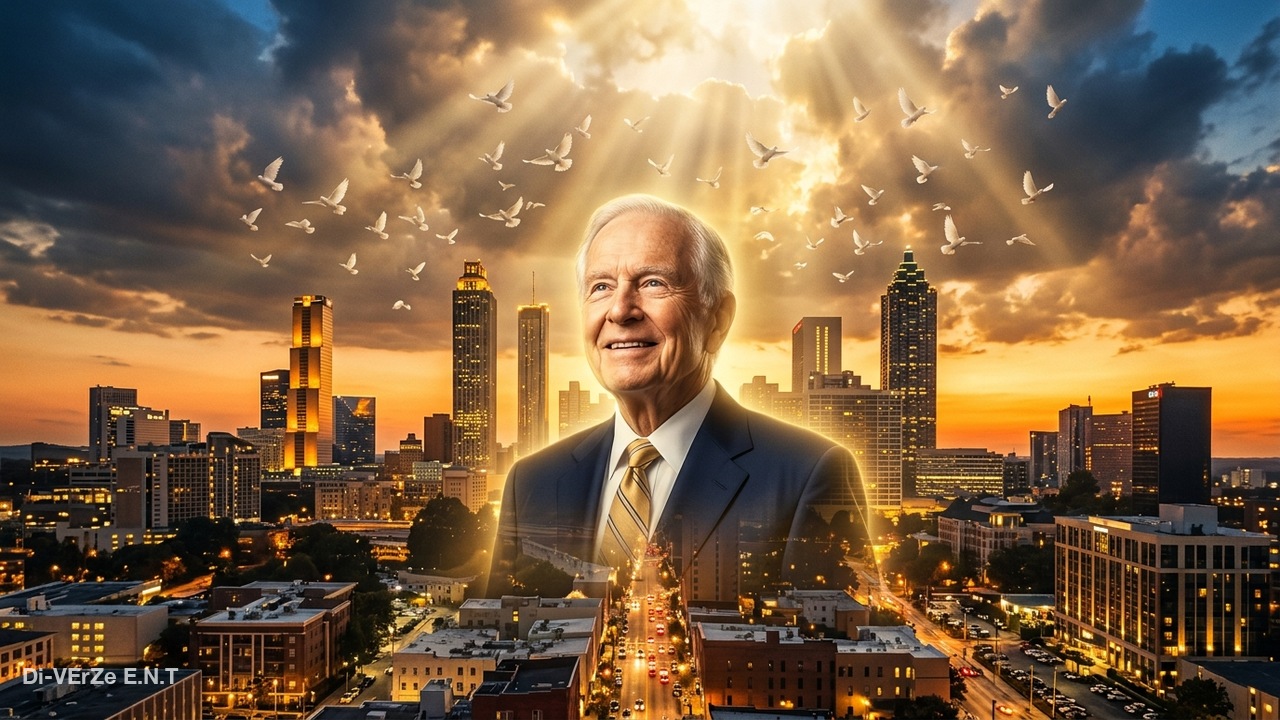
How Ted Turner’s CNN Death Changed an Atlanta Morning
Turner died after a brief time in hospice care, according to reports confirmed by CNN, NPR, and NBC News. His family had publicly known about his Lewy Body Dementia diagnosis since 2018 — the same illness that took Robin Williams — and in recent years his public appearances had slowed to nearly zero. But the city that he helped put on the global map never stopped knowing his name.
Born Robert Edward Turner III in Cincinnati in 1938, Ted Turner moved to Atlanta as a young man and took over his father’s billboard business after his father’s death in 1963. That was supposed to be his story. Instead, it was the opening chapter of something that no one in the media world saw coming.
Turner purchased a struggling Atlanta UHF television station in 1970 — Channel 17 — and turned it into WTBS, a “superstation” that beamed Atlanta Braves games and reruns of classic TV into homes across America via the then-new technology of cable satellite. Before most people understood what cable was, Ted Turner was already building the architecture that would define it.
On June 1, 1980, at 5 PM Eastern, Ted Turner launched CNN from a converted country club in Atlanta, Georgia. He told reporters that day he would keep CNN on the air until the world ended — and then run the footage again as a sign-off. He was 41 years old.
CNN: The Atlanta Station That Became a Global Institution
On June 1, 1980, CNN launched from a converted building in Atlanta as the world’s first 24-hour cable news channel. The established media industry laughed. The three major broadcast networks — ABC, CBS, NBC — dismissed it as “Chicken Noodle News.” Industry veterans called it a vanity project that would bankrupt Turner within a year.
By 1991, CNN was the most-watched broadcast on the planet during the Gulf War. Satellites, live coverage, and the relentless 24-hour format had rewritten every single rule of journalism. The people who laughed in 1980 were watching CNN on their own newsroom monitors.
What Ted Turner understood — what the Atlanta CNN history proves — is that you don’t need permission to disrupt an industry. You need a vision, the resources to execute it, and the refusal to accept that incumbents define what is possible. Every digital media outlet, every YouTube news channel, every podcast, every independent platform that exists today is operating in a world Ted Turner built.
From CNN, Turner went on to found TNT (Turner Network Television) in 1988, Cartoon Network in 1992, and built Turner Broadcasting System into one of the most powerful media conglomerates in history. Time Warner acquired TBS in 1996 for $7.5 billion — at the time one of the largest media mergers ever completed.
The Atlanta Braves, the UN Billion, and the Man Behind the Legend
Turner’s Atlanta fingerprints went deeper than television. In 1976 he purchased the Atlanta Braves — a team that had been struggling to fill Fulton County Stadium. He brought them back to relevance and to a 1995 World Series championship, giving Atlanta one of its most celebrated sports moments. He also owned the Atlanta Hawks from 1977 to 1999, making him one of the rare owners who held both a major league baseball team and an NBA franchise in the same city simultaneously.
In 1997, Turner made global headlines when he pledged $1 billion to the United Nations over ten years — creating the United Nations Foundation. It remains one of the largest single philanthropic gifts in American history. He told the crowd at the UN General Assembly that he was doing it because the UN was broke and needed the money. That was pure Ted Turner: direct, outsized, and impossible to ignore.
He was also an environmental champion years before it was fashionable. Turner owned more land than any private individual in the United States — over two million acres — and dedicated much of it to conservation and bison preservation. His Ted’s Montana Grill restaurant chain even put bison burgers on the mainstream American menu.
Standing on the Shoulders of Giants — Atlanta’s Independent Media Today
Here at Di-VErZe E.N.T, we are keenly aware of what Ted Turner’s Atlanta media legacy means for every independent platform operating out of this city today. We run Di-VErZe HitZ Radio — a 24/7 free streaming station — cover Atlanta culture through Di-VErZe TV, and report on the people and stories that matter most to this city’s community.
We can do all of that because someone walked out of an Atlanta office in 1980 and told the world that the three major TV networks didn’t get to define news anymore. That every city, every community, every independent voice deserved the tools to tell its own story. That conviction — the one Ted Turner acted on — is the DNA of every independent media outlet building something real in Atlanta right now.
Turner was not a perfect man. He was loud, controversial, married five times, known for statements that generated headlines for all the wrong reasons. But his media vision was correct. His bet on Atlanta was correct. And his insistence that the audience — all of us — deserved better information, more information, around the clock, was correct.
The city that built CNN has never stopped producing people willing to challenge the status quo of who gets to tell stories and who gets heard. That legacy belongs to Atlanta as much as it belongs to Turner himself.








Post comments (0)